KEPLER’S LAWS OF PLANETARY MOTION
Categories: Free Courses
Wishlist Share

About Course

1. Introduction

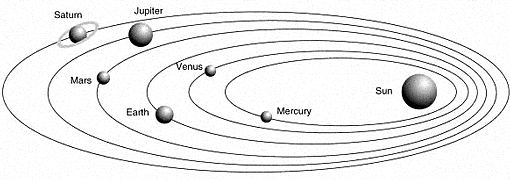
Before Kepler, planets were thought to move in perfect circles.
Johannes Kepler used observational data (from Tycho Brahe) to show that planetary motion follows precise mathematical laws.

These laws describe how planets move around the Sun.

  • Kepler’s First Law (Law of Orbits)
  • Kepler’s Second Law (Law of Areas)
  • Kepler’s Third Law (Law of Periods)

What Will You Learn?

  • Kepler’s three laws explained clearly
  • Orbital motion and speed variation
  • Time period vs distance relation
  • NEET-focused problem solving
  • Concept + application mastery

Course Content

Kepler’s Laws
To understand how planets move, we have to look back at Johannes Kepler, a 17th-century astronomer who used the meticulous observations of Tycho Brahe to shatter the ancient belief that the heavens moved in perfect circles. Kepler’s Three Laws describe the motion of planets around the Sun, shifting our perspective from a "circular" universe to a more complex, mathematical one.

  • Kepler’s First Law (Law of Orbits)
  • Kepler’s Second Law (Law of Areas)
  • Kepler’s Third Law (Law of Periods)
  • KEPLER’S LAWS OF PLANETARY MOTION

Relation with Gravitation
Using Newton's Law of Universal Gravitation, Kepler’s laws can be derived.

Student Ratings & Reviews

No Review Yet
No Review Yet